Introduction
When responding to a question about research integrity, my tutor said,
“…when research became a very good career…”
I used to think research is just an activity, but then I suddenly realised that I need to consider the problems regarding research culture from the angle of career development. Actually, there are two angles to understand research; one is about research itself as an activity/behaviour, another is about the career of researchers, i.e. what motivates a researcher to research.
Since the Enlightenment, scientific research has become an important part of our society, with major changes in research approaches and views derived from various researchers. What drives the change and why it did happen earlier are interesting topics for scientists and historians (Kuhn, 2015). Knott et al. (2008) describe a paradigm of cultural change that can help us to understand culture as a driving force of the change. In the paradigm, a culture can motivate people to behave in a certain way, and the behaviour will be a norm within the culture (Figure 1).
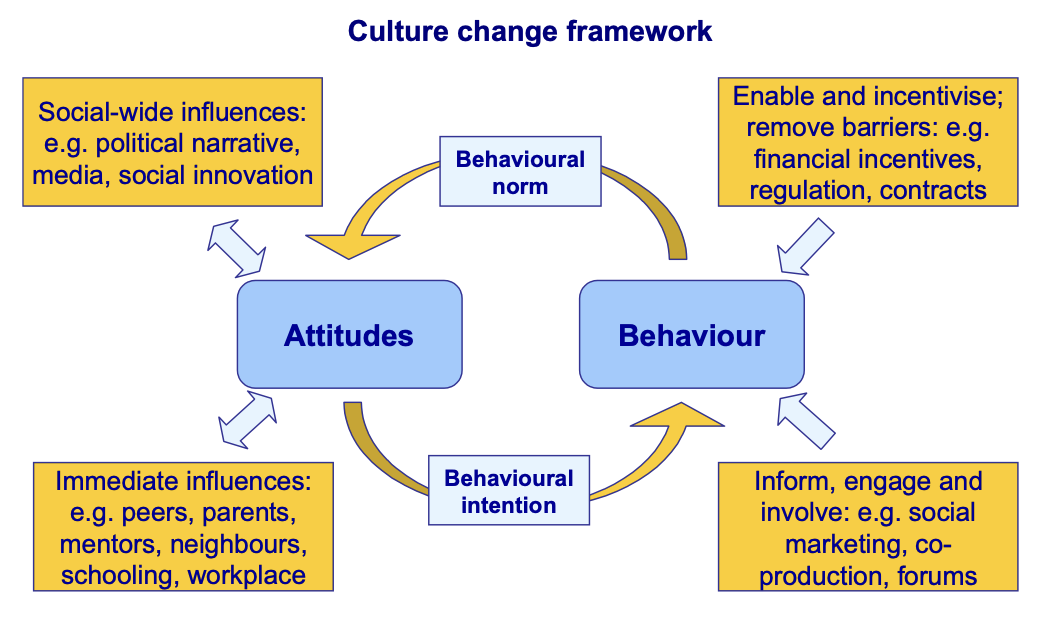
Therefore, research culture is both what motivates people to research, including the intention and incentive of research activity, and how research activity becomes a norm, which reflects the two definitions of research. In this article, we will first review the paradigm of research career to explain the intention to research, then analyse the incentives of individual decisions and finally, describe the process where research becomes a norm. Then, we can provide solutions to problems in current research culture and reflect what makes successes and failures in research.
Kuhn (2015) describes the development of science as a paradigm-driven process, where research may fail to be well appreciated without the proper paradigm to evaluate it. For example, Gregor Mendel’s law of inheritance is well acknowledged as foundations of modern genetics. Yet, at Mendel’s times, nobody thought so, because the way he did research was so different, including the use of well-designed experiments and statistics, that most researchers then found it too difficult to understand (Gustafsson, 1969; Moore, 2001).
Our recognition of Mendel’s work represents a paradigm shift in our research culture, which stresses the use of experiments and statistics. As nobody is born to know how to research, the paradigms of the research community are essential to every researcher when learning and performing researches (Cheetham, 2007), whereas paradigm changes should often be made to appreciate and develop new knowledge. To foster such changes, we should study the current paradigms, including the way we evaluate research outputs, our current approaches to research, then analyse what the current paradigms fail to appreciate, and finally, propose our advice for paradigm shifts.
Discussion
Research career: publish or perish
We should first understand the intention and career goal of being a researcher, especially why they want to publish. Since the birth of modern science, call for communication is part of its ethos, which makes the pressure to publish a natural part of research (Woolf, 1986). On the one hand, researchers will be excited to share the research. Such competition for evidence to promote a theory undoubtedly leads to pressure to publish, yet the pressure does not necessarily lower the quality, as low-quality research cannot defend itself in a competition. In fact, the research approaches today, such as the use of statistics, are far more rigorous than the statistics and experimental approaches that Gregor Mendel used to count peas in order to study the laws of inheritance.
On the other hand, researchers need to publish their work so that people can correctly credit the findings to them. The credit that researchers or research institutions earn is an important metric for investors to decide whether the researchers’ ability to research can be trusted and worth investing, which constitutes a paradigm of research cycle. To continue research, researchers must acquire more grants, which requires them to publish more to prove themselves. All the researchers we interviewed talked about the pressure to publish when they were acquiring a PhD degree or working as a postdoc, which is also when they lack the credit to be a researcher worth funding. Thus, the pressure to publish, fundraising and social recognition are interconnected, as a professor said,
“Certainly, when I was a postdoc, there was still the feeling, of course, that I had to publish. So, I would get an academic position and be able to get grants.”
The crux of the problem is a lack of academic positions and grants for the increasing number of researchers, which leads to intensive competition. In the early 1970s, more than 50% of the PhD graduates in biomedical sciences found tenure/tenure-track positions within five years of graduation, whereas, today, the percentage has dropped to 10.6% (Gibbs et al., 2014). The insecurity of entry and medium level jobs is also downsizing the job market. Although postdocs and PhD students significantly contribute to research, they are not considered formal employees, working long hours without enough pay and legal rights, e.g. maternal/paternal leaves (Livermore and Gallagher, 2015; Ogryzko, 2019), making “publish or perish” more than an undeniable truth for them.
Individual decisions: anxious for novelty
In an individual level, competition may be harmful when it becomes unhealthy. A recent Wellcome Trust survey shows that most researchers find their research culture “competitive” and agree that there is an unhealthy competition in their research culture (Table 1). Over 40% of the PhD and master’s students are suffering from depression and anxiety (Evans et al., 2018), while faculty are also suffering from chronic stress (Lashuel, 2020). Although most of my interviewees mention a balance between pressure and research quality, it is hard in the research community where mental illness prevails, as chronic stress negatively affects decision-making (Porcelli and Delgado, 2017).
Table 1. How do researchers find competition in the research culture? (Shift Learning, 2020)
| Statement | Disagree / Negative | Agree / Positive |
|---|---|---|
| Competition as used to describe research culture is positive/negative | 20% | 56% |
| Unhealthy competition is present within my working environment | 37% | 42% |
| Healthy competition is encouraged within my working environment | 26% | 32% |
| High levels of competition have created unkind and aggressive research conditions | 11% | 78% |
Fulop (2009) considers self-improvement, self-development and co-operation to be crucial to happy competition, whereas a winner-take-all culture stops these from happening. The current incentive for researchers is a combination of funding, academic position in academia and commercial interest from patents in the industry, which only rewards the first. Such individualised incentive is so big that researchers are denying each other’s contribution, as indicated by the patent war over CRISPR involving multiple highly reputable researchers, institutes and companies (Cohen, 2017; Rai and Cook-Deegan, 2017). As Erik Sontheimer pointed out in Science:
“It’s been an incredible fight over credit. Everyone is trying to jockey themselves and minimise what others did.” (Cohen, 2017)
Co-operation has been made uneasy due to the winner-take-all culture which lacks mutual trust, transforming research competition into a prisoner’s dilemma, where the optimal strategy is either trust-based co-operation or distrust-induced betrayal (Kuhn, 2019), leading to little motivation to replicate prior research. In fact, researchers are not encouraged to be true about their research, although motivated to produce more “novel” research (Gyles, 2015; Horton, 2015). In the CRISPR patent war, nobody seems guilty for denying each other’s credit in our current culture, and if they succeed in denying, they earn a lot.
Often, co-operation is only used to create a false sense of reliability for researchers to deceive themselves. People tend to cover up each other when they benefit from cooperative cheating, which is consistent with previous experiments where teamwork promotes cheating (Workman et al., 2013). Actually, teamwork induces diffusion of responsibility, lowering the moral bar for published data quality, including experimental designs and statistical analyses. Such reduced checks on research should be responsible for the replication crisis.
”Passive” education for researchers
In fact, how we co-operate or compete is influenced by our education (Boone and van Witteloostuijn, 1999). Cheetham (2007) attributes our concern over research culture to the commoditisation of higher education, which drives universities to admit more students, hire more researchers and produce more results so they can receive more public funding and private donation. However, what constitutes healthy competition is self-improvement, self-development and co-operation (Fulop, 2009), which universities fail to teach as a result of this shift of focus.
In universities where researchers passively learn to research, mutual help is rarely emphasised. Students start suffering from mental illnesses as they enter college due to all kinds of competition (Macaskill, 2018), with little help from their institution (Eleftheriades et al., 2020), which could accompany them throughout their whole research career. The stress could be responsible for poor decision making (Porcelli and Delgado, 2017), leading to biases in experimental designs and statistical analyses, which are not corrected with enough checks as previously described.
Also, our education does not teach people how to help. First, courses focus on teaching knowledge instead of training transferable skills, such as co-operation and problem-solving, which leads to a lack of cross-disciplinary ability. Second, practical knowledge, such as experiment design and statistical analysis, is not sufficiently delivered to students (Callier et al., 2014; Weissgerber et al., 2016). When students become researchers, they need to learn from scratch in a short time, which is highly stressful and partially erroneous due to lack of training.
Potential solution
First, we should promote an open culture for career changes not limited to academia, as 40% of advanced PhD students are not interested in an academic career due to mismatched expectations (Roach and Sauermann, 2017). For students who feel under-informed of non-academic careers, we should provide internships in different careers, in addition to current career education that emphasises traditional paths. As job insecurity decreases people’s wish to remain postdocs and PhD students despite strong research motivation, similar but more secure jobs, e.g. lab managers, should be introduced for long-term lab support (Shen, 2014).
Second, we should change research incentives and encourage a co-operative culture that rewards reliability. Although more statistical training may reduce common biases and mistakes, self-discipline should not be the only solution, which should be ensured by third-party collaboration, data sharing and technique sharing (Nuzzo, 2015). Funders should require replicability statements (Horton, 2015), and where possible, set up training programmes for students and young researchers to replicate previously funded programmes and publish their findings. Researchers should be allowed to specialise in replication and fraud detection as formal jobs, similar to quality control in manufacturing and auditing in finance. For the modern patent system does not necessarily promote innovation and can impede it (Gallini and Scotchmer, 2002), we should complicate legal procedures and increase fees to reduce confrontation and create room for co-operation.
Third, we should cultivate a culture of mutual support throughout research education, emphasising transferable skills and cross-disciplinary co-operation. Interpersonal skills such as effective communication, proper public engagement and mental support should be taught. Universities and research institutions should provide adequate mental health services. Student projects requiring cross-disciplinary co-operation and real-world scenarios should be part of the curriculum.
Reflection on success and failure
As Stefan (2010) writes:
“As scientists, we construct a narrative of success that renders our setbacks invisible both to ourselves and to others. Often, other scientists’ careers seem to be a constant, streamlined series of triumphs. Therefore, whenever we experience an individual failure, we feel alone and dejected.”
However, no scientist should feel alone and dejected due to their contribution to science that may be recognised later. Our current research culture stresses competition to an unhealthy level. As my tutor said, “…when research became a very good career…” which implies research was not always a good career full of successes. In fact, many excellent researchers were not well recognised in their lifetimes. Before his death, Gregor Mendel, who discovered the laws of inheritance, still vowed, “my time will come” (Gustafsson, 1969).
Another important point is to separate failures in career from failures in science. Rejected PhD/fellowship applications, failed exams and unaccepted papers are not failures in science. Likewise, accepted publications, approved patents and tenure are only parts of personal career development. In some cultures, people tend to mix them up, as if high position or wealth could speak for scientific facts, which is potentially dangerous and should not be part of research culture.